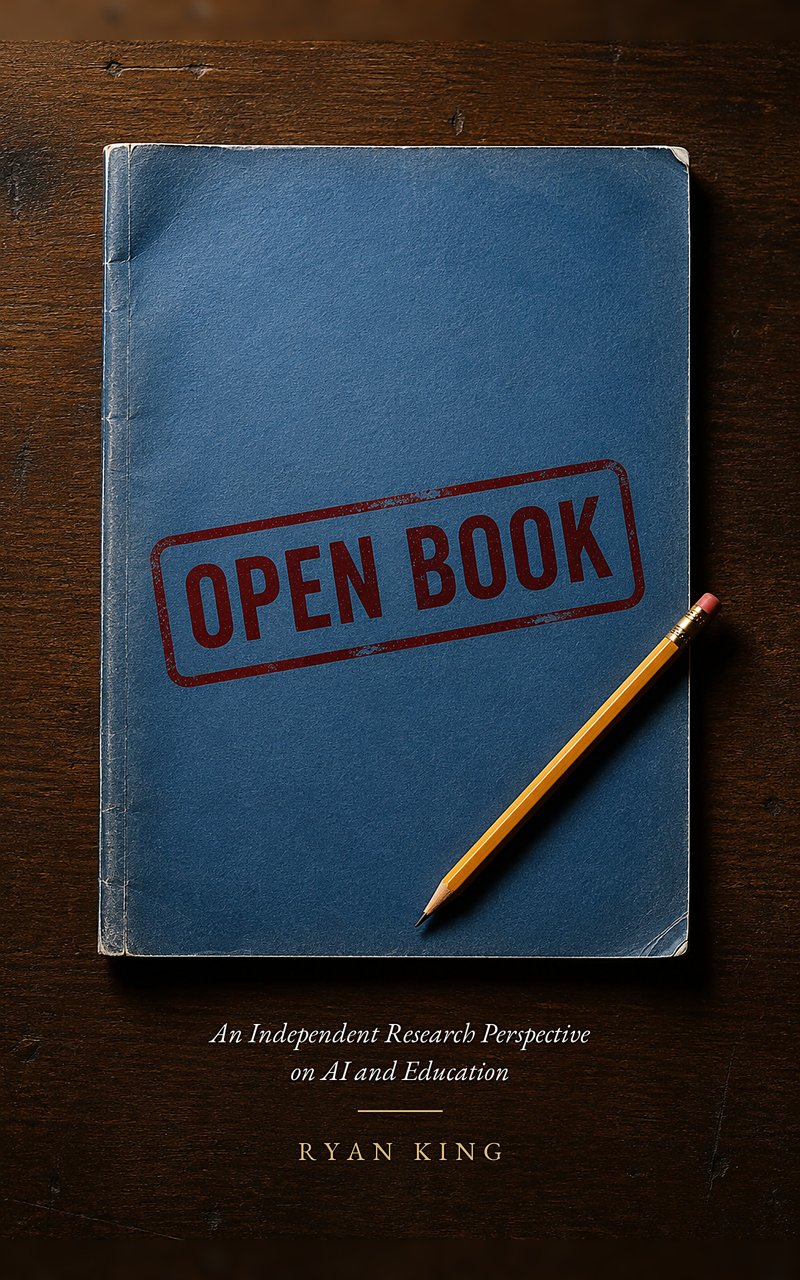
Why I Wrote It
I did not come to this topic as an educator. My clients are the companies that will interview today's students. Then faculty at schools near me started pulling me aside, in quiet conversations that began with "this might be a dumb question" and ended ninety minutes later with an assessment redesign sketched on a napkin. Those conversations turned into research, the research turned into a point of view, and the point of view turned into this book. I also have two sons, who will walk into a school carrying whatever version of this technology exists by then.
The Promise
No dread without data, and no optimism without a mechanism. Where the research is thin, I say so. When the skeptics are right, they get the chapter. Every statistic comes from a named, published source, cited in the notes at the end of each chapter. The book does not ask you to be excited about AI. It asks the adults to understand the thing before ruling on it.
What's Inside
Intelligence became a commodity. Judgment did not.
The cost of machine-generated competence fell more than 280-fold in two years, and it is in every student's pocket. A passable first draft, a competent summary, a B+ analysis: each now costs approximately nothing and arrives in seconds.
Knowing which draft is wrong, which summary misses the point, and which confident paragraph is confidently false has never been scarcer or more valuable. That skill has to be taught on purpose. The book is organized as an argument in four parts, and it ends with a year-long path any school can run.
- 01-03
Part I: The Breach
What actually happened when AI arrived: the panic, the bans, the detectors that failed their own tests, and the cheating wave that never showed up in the data.
- 04-06
Part II: The Mirror
Schools met social media with bans, filters, and assemblies, and a decade of adolescent mental-health data graded that response. AI is the make-up exam.
- 07-10
Part III: The Commodity
What the machine actually is, what it means when intelligence is cheap, what the hiring side has already decided about graduates, and the judgment curriculum.
- 11-15
Part IV: The Pivot
The oral turn in assessment, the posture map of where serious institutions stand, the year-long path from zero tolerance, and the kitchen table.
- Kit
The Field Kit
The working instruments gathered in one place: the five questions, the five real bans, the disclosure line, the age bands, and the year at a glance.
Who It's For
Written for four chairs at the same table.
A book for the adults who run schools, teach in them, and sit on their boards, with a starting point for each.
Heads of School
Read it straight through. The argument is sequenced for you, and the year-long plan in Chapter 13 is yours to steal.
Teachers
Start with Part III: Chapter 7 explains the machine the way every faculty should have heard it in 2022, and Chapter 10 covers the only curriculum that matters now.
Trustees
The fiduciary case is in Parts II and IV, and the Field Kit at the back is designed to be photocopied into your next meeting.
Parents
Start with Chapter 15, which is about your kitchen table, where most of a student's AI life actually happens. Then come back for the reasons.
Get the Book
Class is in session. It has been since November 30, 2022.
The only question left is whether the adults are enrolled.
Get it on Amazon →